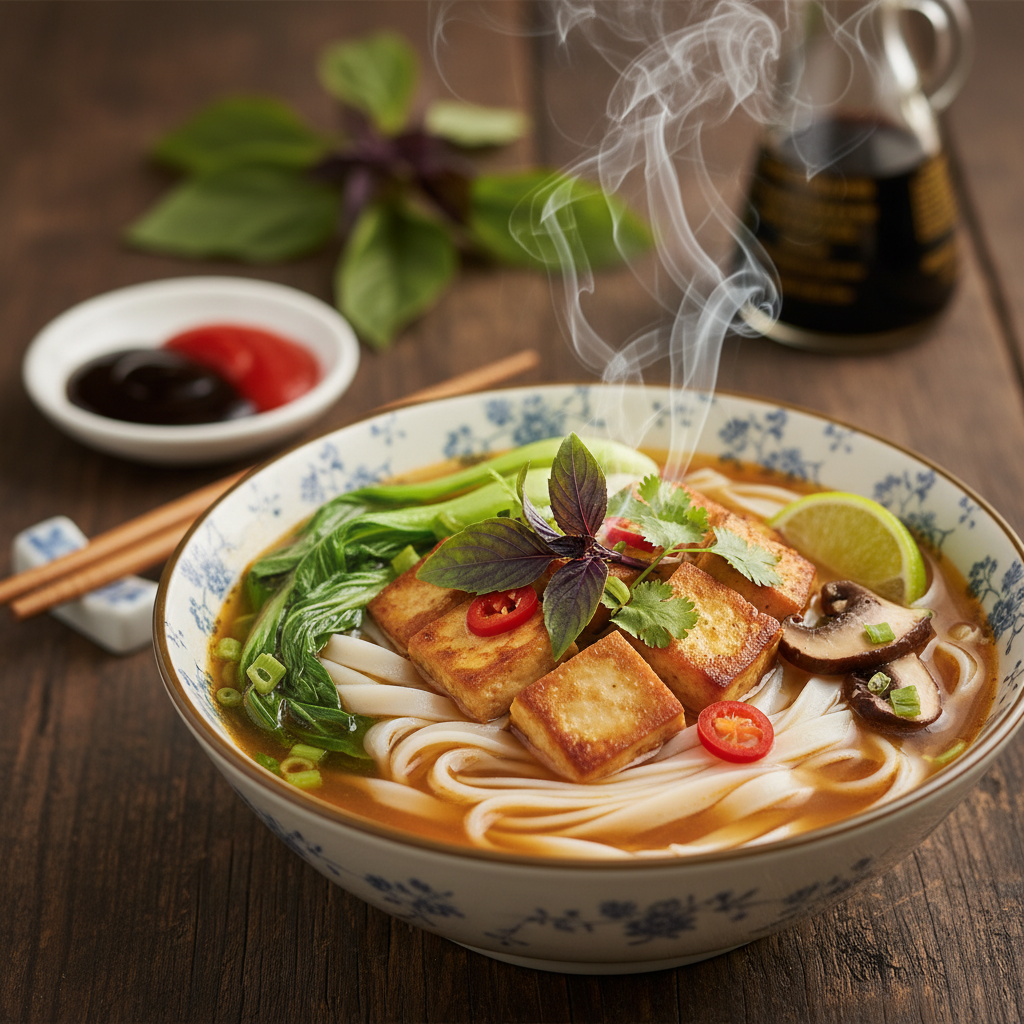
Aromatic & Light Vegetable Pho Style Noodle Soup: The Ultimate 30-Minute Comfort Bowl
Vegetable Pho Style Noodle Soup Light Recipe
Experience the deep, soul-warming flavors of Vietnam with this lighter, plant-based take on traditional Pho. Ready in under an hour, this recipe uses charred aromatics and savory mushrooms to create a broth so rich you won’t believe it’s vegetarian.
15 minutes
30 minutes
45 minutes
4 servings
Main Course
Stovetop
Vietnamese
Vegan
There is perhaps no dish more universally recognized as a comforting embrace than a steaming bowl of Pho. Traditionally, this Vietnamese staple is a labor of love, requiring hours—sometimes days—of simmering beef bones to extract every ounce of marrow and flavor. However, the modern home cook often craves that distinct, aromatic profile without the heavy time commitment or the heaviness of a meat-centric meal. Enter our Vegetable Pho Style Noodle Soup Light Recipe. This dish is designed to bridge the gap between authentic flavor profiles and the need for a wholesome, lighter weeknight dinner.
The magic of this soup lies in its ability to deceive the palate. By utilizing techniques like charring ginger and onions, we replicate the smoky depth usually derived from roasted bones. We infuse a high-quality vegetable base with the classic ‘Pho spices’—star anise, cinnamon, cloves, and coriander seeds—to create a broth that is fragrant, golden, and incredibly restorative. It is a sensory experience from start to finish; the kitchen fills with the scent of toasted spices, and the first sip delivers a complex umami punch that warms you from the inside out.
This ‘light’ version focuses on fresh, vibrant toppings like crisp bean sprouts, pungent Thai basil, spicy chilies, and tangy lime juice, allowing you to customize each bowl. It is naturally gluten-free (when using appropriate hoisin sauce) and packed with vitamins from the bok choy and herbs. Whether you are a dedicated vegetarian, looking to reduce your meat intake, or simply wanting a clean, hydrating meal that doesn’t compromise on taste, this Vegetable Pho is your answer. It is sophisticated enough for a dinner party yet simple enough for a cozy night in.
History & Origins
The history of Pho is as complex and layered as the broth itself. Originating in northern Vietnam in the early 20th century, specifically around the Nam Dinh and Hanoi regions, Pho is believed to be a culinary amalgamation of Vietnamese and French influences. Some historians suggest that the word ‘Pho’ may be derived from the French ‘feu’ (fire), as in ‘pot-au-feu,’ a classic French beef stew that shares the method of charring onions and ginger for the broth. Originally sold by street vendors carrying heavy poles with cabinets at either end, Pho began as a breakfast food, fueling the working class for the day ahead.
While the most famous iteration is Pho Bo (beef pho), followed later by Pho Ga (chicken pho) in the 1930s, the vegetarian version, known as Pho Chay, has deep roots in Vietnam’s Buddhist culture. On the first and fifteenth days of the lunar month, many Vietnamese observe a vegetarian diet for religious reasons. To maintain the culinary tradition of noodle soup without violating dietary precepts, cooks developed ingenious ways to mimic the savory depth of meat broths using daikon radishes, onions, carrots, and an abundance of roasted spices.
Following the partition of Vietnam in 1954, over a million northerners migrated south, bringing their beloved soup with them. In the south, the dish evolved; the broth became slightly sweeter, and the garnish plate became more elaborate, featuring the mountain of herbs, bean sprouts, and lime wedges we associate with Pho today. This recipe pays homage to that evolution, leaning towards the southern style with its generous herb accompaniments while respecting the northern tradition of a clear, spice-forward broth. It represents the adaptability of Vietnamese cuisine and its global journey from Hanoi street corners to American kitchens.
Why This Recipe Works
This recipe succeeds where many vegetable soups fail because it prioritizes the architecture of flavor. Often, vegetable broths can taste thin or one-dimensional, lacking the ‘mouthfeel’ of bone broths. To counteract this, we employ three critical techniques. First, **charring the aromatics**. By blistering the onion and ginger until they are blackened, we release natural sugars and introduce a smoky complexity that mimics the savory depth of roasted meat. This is the non-negotiable secret to authentic Pho taste.
Second, we use **toasted whole spices**, not ground powder. Toasting the star anise, cinnamon, cloves, and coriander seeds releases their essential oils before they even hit the water. Simmering them whole allows for a clean, clear broth that is infused with flavor but not muddy or gritty.
Third, we layer **umami sources**. Soy sauce (or tamari) provides the salt base, but the addition of dried shiitake mushrooms (if available) or simply allowing the broth to simmer with fresh mushrooms creates a natural glutamate boost. We also keep the noodles separate until serving. Rice noodles release starch that can cloud the broth and make it gloopy; by cooking them separately and combining them at the last second, we ensure the soup remains light, silky, and refreshing. The result is a bowl that feels heavy on satisfaction but light on the stomach.
Why You’ll Love This Recipe
- ✓Ready in under 45 minutes compared to traditional 8-hour recipes.
- ✓Charred ginger and onion create a deep, smoky, restaurant-quality broth base.
- ✓Low in calories and fat, making it a perfect light lunch or dinner.
- ✓Highly customizable with various vegetables and protein sources like tofu or seitan.
- ✓Naturally gluten-free and vegan (check your Hoisin sauce ingredients).
- ✓Packed with fresh herbs that provide a burst of antioxidants and flavor.
Equipment You’ll Need
- ✓Large soup pot or Dutch oven
- ✓Tongs
- ✓Baking sheet or gas stovetop burner (for charring)
- ✓Fine mesh strainer
- ✓Separate pot for boiling noodles
- ✓Soup ladles
Ingredients
- ✓2 large onions, peeled and halved
- ✓4-inch piece of fresh ginger, halved lengthwise
- ✓4 quarts high-quality vegetable broth (low sodium preferred)
- ✓5 whole star anise
- ✓3 cinnamon sticks
- ✓1 tsp whole cloves
- ✓1 tbsp coriander seeds
- ✓1 lb dried flat rice noodles (banh pho)
- ✓2 tbsp soy sauce or tamari
- ✓1 tbsp sugar or maple syrup (optional, for balance)
- ✓8 oz firm tofu, cubed or sliced
- ✓8 oz mushrooms (shiitake or cremini), sliced
- ✓2 heads baby bok choy, quartered
- ✓1 cup bean sprouts
- ✓1 bunch fresh Thai basil
- ✓1 bunch fresh cilantro
- ✓1/2 cup scallions, thinly sliced
- ✓1-2 jalapeños or Thai chilies, sliced
- ✓2 limes, cut into wedges
- ✓Hoisin sauce and Sriracha for serving
Instructions
- Char the Aromatics: If you have a gas stove, use tongs to hold the onion halves and ginger pieces directly over the flame until they are charred and blackened in spots (about 3-5 minutes). Alternatively, place them on a baking sheet and broil in the oven on high for 10-15 minutes, flipping once, until charred.
- Toast the Spices: In a large dry soup pot over medium heat, add the star anise, cinnamon, cloves, and coriander seeds. Toast for 1-2 minutes until fragrant, shaking the pan frequently to prevent burning.
- Simmer the Broth: Add the vegetable broth to the pot with the spices. Add the charred onion and ginger. Bring the mixture to a boil, then reduce heat to low. Cover and simmer for at least 20 minutes (30 is better) to infuse the flavors.
- Strain and Season: Use a slotted spoon or fine mesh strainer to remove the onion, ginger, and whole spices from the broth. Stir in the soy sauce (or tamari) and sugar. Taste and adjust saltiness. Add the sliced mushrooms and tofu to the broth and simmer for another 5-8 minutes until mushrooms are tender.
- Cook the Noodles: While the broth simmers, bring a separate pot of water to a boil. Cook the rice noodles according to package instructions (usually 3-5 minutes). Drain immediately and rinse with cold water to stop the cooking and wash away excess starch.
- Blanch Bok Choy: In the last 2 minutes of the broth simmering, toss in the bok choy quarters just until they are bright green and slightly tender.
- Assemble: Divide the cooked noodles among four large bowls. Ladle the hot broth, tofu, mushrooms, and bok choy over the noodles.
- Garnish: Serve immediately with a platter of bean sprouts, Thai basil, cilantro, scallions, chilies, and lime wedges on the side. Allow guests to add herbs and sauces (Hoisin/Sriracha) to taste.
Expert Cooking Tips
- ✓Don’t Skip the Char: The charring of the onion and ginger is the single most important step for authentic flavor. Do not scrub the black bits off; they add color and flavor.
- ✓Rinse the Noodles: Rice noodles get gummy very quickly. Rinsing them in cold water right after boiling is crucial for a good texture.
- ✓Broth Quality: Since this is a vegetable soup, the quality of your base stock matters. If using store-bought, buy the best quality available, or use a mushroom-based broth for deeper color.
- ✓Herb Freshness: The herbs are not just garnish; they are a main component. Ensure your basil and cilantro are vibrant and fresh.
- ✓Toast Spices Carefully: Spices can burn quickly. Watch them closely during the toasting phase; as soon as you smell them, they are ready.
- ✓Serving Temperature: Ensure the broth is boiling hot when you ladle it over the noodles to warm them back up instantly.
Substitutions and Variations
This recipe is incredibly flexible. If you cannot find **Thai Basil**, regular Italian basil is a passable substitute, though it lacks the anise-like flavor; mint is actually a better alternative for freshness. For the **protein**, you can swap tofu for seitan, edamame, or even thinly sliced raw vegetables like zucchini that will soften in the hot broth. If **rice noodles** are unavailable, you can use pad thai noodles, vermicelli, or even udon for a fusion twist, though flat rice noodles are traditional. For a **soy-free** version, use coconut aminos instead of soy sauce. If you don’t have **whole spices**, you can use a pinch of Chinese Five Spice powder, but use it sparingly as it is potent and can make the broth cloudy. **Bok choy** can be replaced with spinach, kale, or broccoli florets.
Common Mistakes to Avoid
The most common mistake is **overcooking the noodles**. Rice noodles are delicate; if you boil them too long, they disintegrate into mush. It is better to slightly undercook them, as the hot broth will finish the job in the bowl. Another error is **crowding the pot** with too many starchy vegetables, which can muddy the clear broth. Keep the broth clear and cook starchy items separately if needed. Finally, **under-seasoning the broth**. Pho broth should taste slightly too salty on its own because the unseasoned noodles and fresh bean sprouts will dilute the flavor significantly once combined. Don’t be afraid to add that extra splash of soy sauce or pinch of salt.
Serving Suggestions
Serve this Vegetable Pho in deep, wide bowls to accommodate the broth and the generous heap of toppings. It is traditionally served with a side plate (the garnish plate) containing the bean sprouts, herbs, lime, and chilies so each diner can ‘doctor’ their soup. Provide chopsticks for the noodles and solid ingredients, and a deep Asian-style soup spoon for the broth. A small side dish of Hoisin sauce and Sriracha mixed together allows for dipping the tofu or mushrooms. For a beverage pairing, a cold jasmine tea, Vietnamese iced coffee (Ca Phe Sua Da), or a crisp, dry Riesling cuts through the savory spice of the broth perfectly.
Storage and Reheating Tips
Pho is excellent for meal prep, but **storage requires separation**. Never store the noodles in the broth, or they will absorb all the liquid and become bloated and mushy. Store the broth (with mushrooms and tofu) in an airtight container in the refrigerator for up to 4 days. Store the cooked noodles in a separate container or Ziploc bag; they will harden in the fridge but soften instantly when reheated. The fresh herbs and sprouts should be washed and stored separately wrapped in damp paper towels. To reheat, bring the broth to a boil on the stove. You can microwave the noodles for 30 seconds or simply drop them into the boiling broth for 1 minute before serving. The broth freezes beautifully for up to 3 months, but freeze it without the tofu for best texture.
Nutrition Facts (Estimated)
| Serving Size | 1 large bowl |
| Calories | 320 |
| Fat | 6g |
| Saturated Fat | 1g |
| Unsaturated Fat | 4g |
| Trans Fat | 0g |
| Cholesterol | 0mg |
| Sodium | 980mg |
| Carbohydrates | 58g |
| Fiber | 4g |
| Sugar | 6g |
| Protein | 12g |
Frequently Asked Questions
Can I make this recipe in an Instant Pot?
Absolutely. Char your ginger and onions using the Sauté function, then add all broth ingredients (except noodles and delicate veggies). Cook on High Pressure for 15 minutes, then Quick Release. Strain and proceed.
Is this recipe gluten-free?
Yes, the core ingredients (rice noodles, vegetables, broth) are gluten-free. However, you must ensure your Soy Sauce (use Tamari) and Hoisin sauce are certified gluten-free, as many commercial brands contain wheat.
What creates the umami flavor without meat?
The combination of charred aromatics, soy sauce/tamari, and mushrooms creates the savory depth. Using dried shiitake mushrooms in the simmering step boosts this significantly.
Can I use dried herbs instead of fresh?
It is not recommended. The fresh herbs (basil, cilantro, mint) provide a textural crunch and a burst of volatile oils that dried herbs simply cannot replicate in this dish.
Why is my broth cloudy?
Cloudiness usually comes from boiling the noodles directly in the broth (releasing starch) or boiling the soup too vigorously. simmer gently and cook noodles separately.
How can I make the broth spicy?
The traditional way is to add sliced jalapeños or bird’s eye chilies to the finished bowl. You can also add Sriracha or chili oil directly to the broth while eating.
Can I use zucchini noodles (zoodles) instead of rice noodles?
Yes, for a lower-carb or keto-friendly version, zucchini noodles work well. Just add them raw to the hot broth; do not pre-cook them or they will get soggy.
What is the best type of onion to use?
Yellow onions or white onions are standard. Red onions can be used but may slightly discolor the broth. Shallots are also an excellent, more traditional addition.
Do I have to use star anise?
Star anise is the signature flavor of Pho. Without it, the soup will taste like a generic vegetable soup rather than Pho. It is highly recommended to include it.
How do I get the ginger to char properly?
Cut the ginger in half lengthwise to create a flat surface. Place that flat surface directly on the grill grate, gas burner, or dry cast-iron skillet until black. Don’t move it around too much.
Conclusion
Making Vegetable Pho at home is a rewarding experience that demystifies one of the world’s most beloved soups. It proves that you don’t need meat to achieve a broth that is rich, complex, and deeply satisfying. This light recipe is a testament to the power of simple ingredients treated with care—charring, toasting, and simmering to perfection. Whether you are looking for a healing meal during cold and flu season, a light post-holiday detox dinner, or simply a delicious way to eat more plants, this bowl of noodles is waiting to become a staple in your kitchen rotation. Gather your ingredients, toast your spices, and get ready to slurp your way to comfort.