Creamy Coconut Chia Seed Pudding: The Ultimate 4-Ingredient Dessert
Chia Seed Pudding With Coconut Milk Dessert Recipe
Discover the magic of this velvety, ultra-creamy Chia Seed Pudding made with rich coconut milk. It is a naturally gluten-free, vegan dessert that requires zero cooking and tastes like an indulgent treat while packing a nutritional punch.
10 minutes
0 minutes (plus 4 hours chilling)
4 hours 10 minutes
4 Servings
Dessert
No-Cook / Refrigeration
American / Health Food
Vegan
If there is one recipe that perfectly bridges the gap between a wholesome breakfast and a decadent dessert, it is undoubtedly this Creamy Coconut Chia Seed Pudding. For years, chia pudding has circulated on Pinterest boards and wellness blogs, often touted solely for its health benefits. However, many recipes miss the mark on texture, resulting in a watery, lackluster mixture that feels more like a chore to eat than a reward. This recipe changes everything. By utilizing full-fat canned coconut milk, we transform the humble chia seed into a luxurious, custard-like vessel that rivals traditional dairy puddings in richness and mouthfeel.
The beauty of this dish lies in its simplicity. It requires no stove, no baking, and barely any active preparation time. It is the epitome of ‘set it and forget it.’ The magic happens in the refrigerator, where the chia seeds work their hydrocolloid wonders, absorbing the coconut milk to create a thick, gel-like consistency that is both satisfying and refreshing. The flavor profile is clean and tropical, with the natural sweetness of coconut elevated by a touch of pure maple syrup and vanilla bean paste. It is a blank canvas awaiting your creativity—whether you layer it with tart berry compote, crunchy homemade granola, or a drizzle of dark chocolate, this pudding adapts to your cravings. Whether you are a busy parent looking for a grab-and-go snack, a fitness enthusiast seeking post-workout recovery fuel, or simply someone with a sweet tooth trying to cut back on refined sugars, this coconut chia pudding is your new kitchen staple. It is proof that healthy food does not have to taste like ‘health food’—it can be lush, creamy, and utterly delicious.
History & Origins
The story of the chia seed is as ancient as it is fascinating, rooting deep into the history of Mesoamerica. The plant, *Salvia hispanica*, is a member of the mint family and was a staple crop for the Aztec and Mayan civilizations as early as 3500 B.C. In fact, the word ‘chia’ is derived from the Mayan word for ‘strength.’ Legend has it that Aztec warriors and Tarahumara runners would consume these tiny seeds to sustain themselves during long expeditions and battles, relying on the dense energy and hydration properties the seeds provided. For centuries, chia was revered not just as food, but as currency and a sacred offering to the gods.
However, with the Spanish conquest, chia cultivation was largely suppressed in favor of European crops like wheat and barley, and the seed faded into obscurity for hundreds of years. It wasn’t until the late 20th and early 21st centuries that chia experienced a massive resurgence, driven by the modern wellness movement and a growing interest in ancient grains and superfoods. The concept of ‘chia pudding’ is a relatively modern culinary invention, born out of the raw food and vegan movements of the 2000s. Innovators in these communities discovered that when soaked in liquid, the seeds developed a gelatinous coating (mucilage), mimicking the texture of tapioca pudding without the need for cooking or starches. The adaptation of using coconut milk, a staple in Southeast Asian, Caribbean, and South American cuisines, was a natural evolution. It married the tropical, rich culinary traditions of the equator with the ancient energy source of the Aztecs, creating the modern, global phenomenon we see on social media feeds today.
Why This Recipe Works
This recipe succeeds where many others fail primarily due to the specific ratio of liquid to seeds and the choice of liquid itself. Many standard chia pudding recipes call for almond milk or skim milk, which often results in a thin, runny consistency that separates easily. By using full-fat canned coconut milk, we introduce a higher fat content which does two crucial things: it suspends the seeds more effectively, preventing them from sinking to the bottom before they gel, and it provides a creamy mouthfeel that coats the tongue, signaling ‘dessert’ to the brain rather than ‘health food.’
Furthermore, the science of the chia seed is paramount here. Chia seeds are hydrophilic, meaning they love water; they can absorb up to 10-12 times their weight in liquid. However, they need time and agitation to do this evenly. This recipe incorporates a crucial ‘second stir’ technique. If you simply mix the seeds and milk and walk away, the seeds will clump together in a solid mass at the bottom of the jar. By stirring the mixture initially, waiting five minutes, and then stirring again vigorously, we break up the initial clumps and ensure each seed is surrounded by liquid. This allows for maximum absorption and expansion, resulting in a uniform, tapioca-like texture throughout the entire jar. The addition of a liquid sweetener like maple syrup also dissolves instantly, ensuring no gritty sugar texture interferes with the smoothness of the pudding.
Why You’ll Love This Recipe
- ✓Requires only 4 main ingredients found in most pantries.
- ✓Completely vegan, gluten-free, and dairy-free.
- ✓Rich in Omega-3 fatty acids, fiber, and healthy fats.
- ✓Perfect for meal prep; stays fresh in the fridge for up to 5 days.
- ✓Highly customizable with endless topping variations.
- ✓Zero cooking required—just mix and chill.
Equipment You’ll Need
- ✓Medium mixing bowl
- ✓Whisk or fork
- ✓Measuring cups and spoons
- ✓4 Mason jars or glass containers with lids
- ✓Spatula
Ingredients
- ✓1 can (13.5 oz) full-fat coconut milk
- ✓1/2 cup water (or plant-based milk for thinner consistency)
- ✓1/2 cup chia seeds (black or white)
- ✓2-3 tablespoons pure maple syrup (adjust to taste)
- ✓1 teaspoon pure vanilla extract
- ✓1 pinch sea salt
- ✓Optional garnish: Fresh berries, toasted coconut flakes, mango slices
Instructions
- Open the can of full-fat coconut milk. If the cream has separated from the water, pour the entire contents into a blender or a bowl and whisk vigorously until completely smooth and emulsified.
- In a medium mixing bowl, combine the smooth coconut milk, water, maple syrup, vanilla extract, and sea salt. Whisk until the sweetener is fully dissolved.
- Add the chia seeds to the liquid mixture. Whisk immediately and thoroughly to distribute the seeds. Do not let them sit on top.
- Let the mixture sit on the counter for about 5 to 10 minutes. This is the most critical step.
- After the resting period, whisk the mixture again vigorously. You will notice it has already started to thicken slightly. This second mix breaks up any clumps that formed during the initial hydration phase.
- Pour the mixture evenly into 4 mason jars or glass containers.
- Cover the jars tightly with lids and place them in the refrigerator.
- Chill for at least 4 hours, but preferably overnight. The longer it sits, the thicker and creamier it will become.
- Before serving, give the pudding a gentle stir. If it is too thick for your liking, add a splash of almond milk to loosen it up.
- Top with fresh fruits, nuts, or granola immediately before serving.
Expert Cooking Tips
- ✓The ‘Second Stir’ is non-negotiable. If you skip stirring after 5 minutes, you will end up with a solid block of seeds at the bottom and liquid on top.
- ✓Use full-fat coconut milk for a dessert-like texture. ‘Lite’ coconut milk works but will yield a thinner, less satisfying pudding.
- ✓Check your chia seeds. Old seeds may not absorb liquid as well. If your pudding is runny after 4 hours, your seeds might be past their prime.
- ✓Adjust sweetness to taste. If you are strictly watching sugar, you can use stevia or monk fruit sweetener instead of maple syrup.
- ✓For a smoother texture closer to traditional pudding, you can blend the mixture in a high-speed blender *after* the chia seeds have soaked and expanded.
- ✓Toasting coconut flakes for the topping adds a necessary crunch to contrast the soft texture of the pudding.
- ✓If you dislike the texture of chia seeds entirely, try grinding them into a powder before mixing; this creates a smooth mousse-like consistency.
Substitutions and Variations
This recipe is incredibly resilient and adapts well to various dietary needs. If you do not have canned coconut milk, you can use carton coconut milk, almond milk, oat milk, or soy milk; however, be aware that the result will be much thinner and less creamy. To compensate for the lack of fat in these alternatives, try mixing in a tablespoon of almond butter or Greek yogurt. For the sweetener, honey is a fantastic non-vegan alternative that adds floral notes, while agave nectar provides a neutral sweetness. If you are following a Keto or low-carb diet, swap the maple syrup for a liquid monk fruit sweetener or erythritol. You can also experiment with flavor extracts; swap vanilla for almond extract for a marzipan-like flavor, or add a tablespoon of cocoa powder to the liquid base to create a rich chocolate version. If you don’t have chia seeds, basil seeds are the closest biological alternative and behave similarly, though they are harder to find.
Common Mistakes to Avoid
The most frequent mistake people make is impatience. Eating the pudding after only one or two hours often leads to a crunchy, slimy texture because the seeds haven’t fully hydrated. Another common error is using the wrong type of coconut milk. Using ‘cream of coconut’ (which is heavily sweetened and used for cocktails) instead of ‘coconut milk’ will result in a cloyingly sweet disaster. Conversely, using a very watery rice milk without adjusting the seed ratio will result in a ‘soup’ rather than a pudding. Finally, failing to whisk thoroughly is the downfall of many puddings. If you see clumps of dry seeds in your finished product, it means the liquid never reached the center of that clump, and it will be unpleasant to eat.
Serving Suggestions
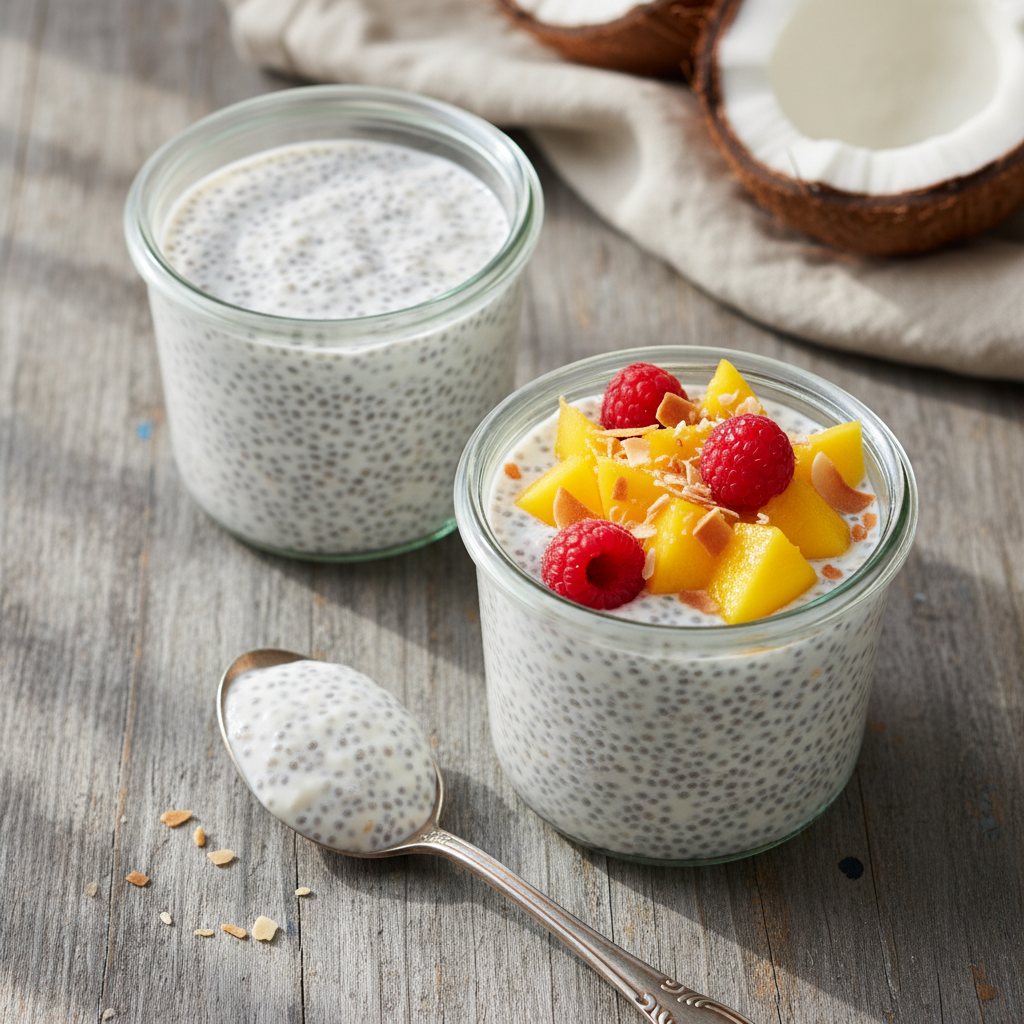
While delicious on its own, this pudding shines when dressed up. Serve it in clear glass jars to show off the creamy white color. For a tropical vibe, top with diced fresh mango, kiwi, and a sprinkle of hemp hearts. For a dessert profile, layer the pudding with crushed graham crackers and key lime zest for a ‘Key Lime Pie’ effect. It also works beautifully as a breakfast parfait layered with Greek yogurt and berry compote. In the colder months, you can actually warm the set pudding gently in the microwave for 30 seconds for a ‘warm porridge’ style comfort food. Serve with a small spoon to encourage savoring the rich texture.
Storage and Reheating Tips
Chia pudding is a meal-prep champion. Stored in airtight containers like mason jars, it will keep well in the coldest part of your refrigerator for up to 5 days. Note that it may continue to thicken slightly over time; simply stir in a teaspoon of water or milk to restore the consistency before eating. Freezing is possible but not highly recommended as the texture of the gel can change upon thawing, becoming somewhat watery or grainy. If you must freeze it, do so in individual portions and blend it with a frozen banana upon thawing to re-emulsify the texture.
Nutrition Facts (Estimated)
| Serving Size | 1 jar (approx 1/2 cup) |
| Calories | 285 |
| Fat | 22g |
| Saturated Fat | 18g |
| Unsaturated Fat | 4g |
| Trans Fat | 0g |
| Cholesterol | 0mg |
| Sodium | 15mg |
| Carbohydrates | 18g |
| Fiber | 8g |
| Sugar | 9g |
| Protein | 5g |
Frequently Asked Questions
Why is my chia pudding runny?
Runny pudding usually means either not enough time was allowed for chilling, or the ratio of seeds to liquid was off. Ensure you wait at least 4 hours. If it is still runny, add another tablespoon of seeds and wait 30 minutes.
Can I blend the chia seeds?
Absolutely. Blending the mixture produces a smooth, mousse-like texture that eliminates the ‘bumpy’ consistency some people dislike. You can blend the seeds dry before mixing, or blend the whole pudding after it sets.
Is canned coconut milk healthy?
Canned coconut milk is high in saturated fats, specifically medium-chain triglycerides (MCTs), which are metabolized differently than other fats and can provide quick energy. However, it is calorie-dense, so moderation is key.
Can I use frozen fruit for toppings?
Yes, frozen fruit works great. As it thaws, it releases natural juices that create a delicious syrup layer on top of the pudding.
Do I have to use maple syrup?
No, you can use any sweetener you prefer. Honey, agave, date syrup, or sugar-free alternatives like Stevia all work well. Granulated sugars may need more whisking to dissolve.
Is this recipe Keto-friendly?
The base recipe is high in fat and fiber, which is great for Keto, but maple syrup is high in carbs. Swap the maple syrup for a keto-friendly sweetener like liquid monk fruit to make it compliant.
Can I heat this up?
Yes! While usually served cold, warm chia pudding is delicious. Heat it gently on the stove or in the microwave just until warm.
Why did my coconut milk separate?
Natural separation occurs in cans without stabilizers. This is normal. Just pour the solids and liquids into a bowl and whisk or blend them back together before measuring.
Conclusion
There is something incredibly satisfying about opening the fridge in the morning (or late at night) to find a perfectly set, creamy jar of Coconut Chia Seed Pudding waiting for you. It is a testament to how a few simple, whole-food ingredients can come together to create something that feels indulgent yet nourishes your body from the inside out. Whether you are a chia veteran or a skeptic of the texture, I urge you to try this full-fat coconut milk version. It elevates the experience from a simple health hack to a genuine culinary delight. So, grab those mason jars, give that mixture a good whisk, and enjoy the creamy, dreamy results of your minimal labor. Happy pudding making!