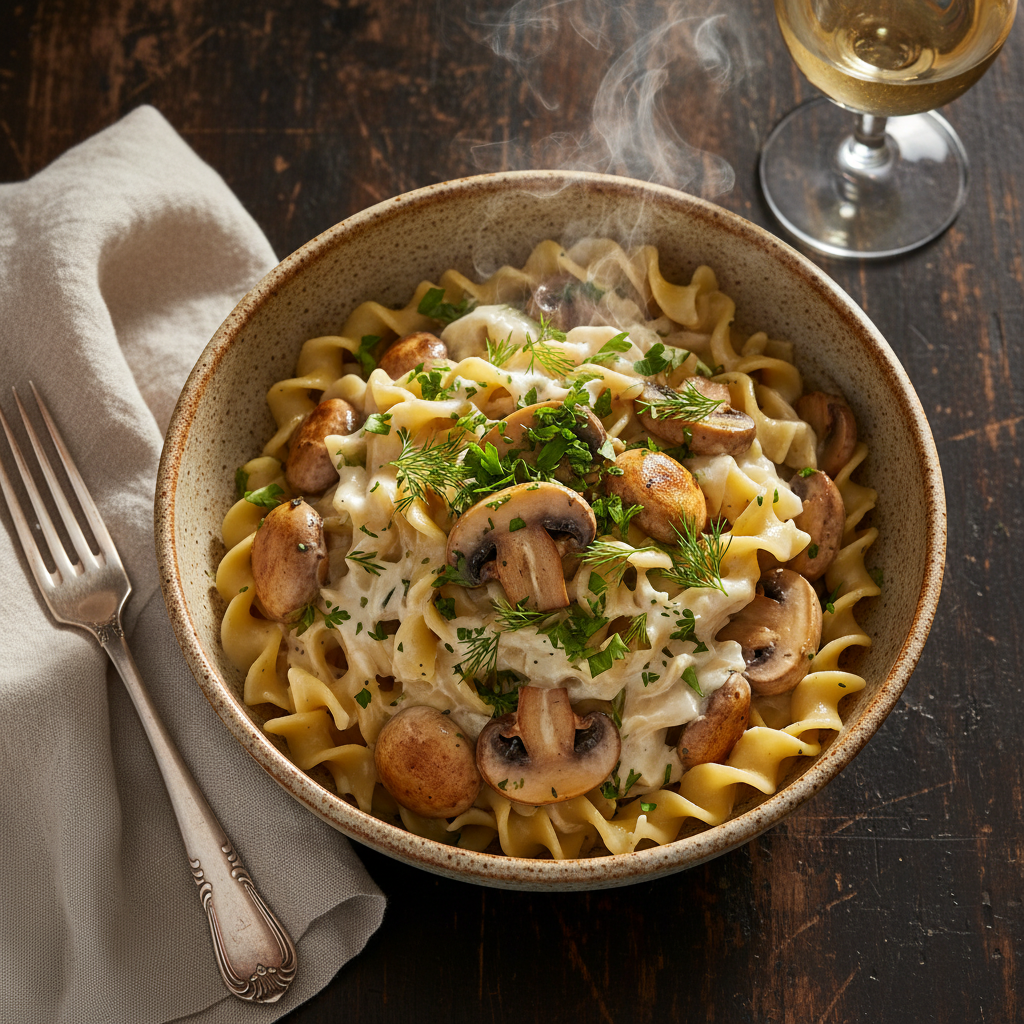
Creamy Mushroom Stroganoff With Greek Yogurt Sauce: A Healthy 30-Minute Dinner
Mushroom Stroganoff With Greek Yogurt Sauce Recipe
Experience the ultimate comfort food makeover with this Creamy Mushroom Stroganoff. By swapping heavy cream for Greek yogurt, we create a tangy, protein-packed sauce that perfectly coats tender mushrooms and egg noodles, ready in just 30 minutes.
15 minutes
20 minutes
35 minutes
4 servings
Main Course
Stovetop
Russian-American Fusion
Vegetarian
There are few dishes that evoke the feeling of home quite like Stroganoff. Traditionally a heavy, rich dish laden with sour cream and beef, it has long been a staple of comfort food cooking. However, in the modern kitchen, we often crave that same depth of flavor without the accompanying heaviness that leaves you feeling sluggish. Enter this Mushroom Stroganoff with Greek Yogurt Sauce—a revelation in texture and taste that transforms a caloric splurge into a nutritious weeknight staple. This recipe is a celebration of umami, highlighting the earthy, meaty texture of cremini and shiitake mushrooms, which stand in beautifully for beef. The magic, however, lies in the sauce. By utilizing thick, full-fat Greek yogurt, we achieve a velvety consistency that rivals heavy cream but brings a delightful tangy brightness that cuts through the savory notes of the mushrooms and garlic.
This dish is designed for the busy home cook who refuses to compromise on flavor. It comes together in one skillet (plus a pot for noodles) and relies on pantry staples you likely already have. The aroma of onions sweating in butter, combined with fresh thyme and white wine, will fill your kitchen with a scent that promises a delicious meal. Whether you are a strict vegetarian or a meat-eater looking to incorporate more plant-based meals into your rotation, this stroganoff satisfies the craving for something hearty and saucy. It pairs perfectly with a crisp green salad or steamed green beans, making it a balanced meal that feels indulgent. Get ready to redefine your perception of ‘healthy’ food with a bowl of this creamy, savory goodness.
History & Origins
The history of Stroganoff is as rich and layered as the sauce itself, tracing its roots back to 19th-century Russia. The dish is named after the influential Stroganoff family, specifically Count Pavel Stroganoff, a dignitary in the court of Alexander III. While the exact origin story is debated, food historians generally agree that the recipe was created by the Count’s French chef, André Dupont. Dupont combined the classic French technique of making a pan sauce (using mustard and a roux) with the Russian preference for sour cream (smetana). The result was ‘Beef Stroganoff,’ a dish that bridged the gap between French culinary refinement and Russian heartiness.
The first written recipe appeared in the classic 1861 Russian cookbook ‘A Gift to Young Housewives’ by Elena Molokhovets. Originally, it was a simple affair of beef cubes prepared with mustard and bouillon, finished with a small amount of sour cream—no onions or mushrooms were present in the earliest version. Following the Russian Revolution and the dispersion of Russian immigrants, the dish traveled globally, evolving significantly along the way. In China, it was spiced up; in Brazil, it was served with potato sticks. However, it was in mid-20th century America that it truly exploded in popularity, often simplified using ground beef and cream of mushroom soup. Today’s version, using mushrooms as the star and Greek yogurt as the binding agent, represents the latest evolution: a shift towards health-conscious, plant-forward eating that honors the tangy, savory profile of the original masterpiece while adapting to modern dietary needs.
Why This Recipe Works
This recipe succeeds where many ‘healthy’ adaptations fail because it understands the chemistry of cooking with yogurt and mushrooms. First, we focus on the Maillard reaction. By searing the mushrooms in batches rather than steaming them in a crowded pan, we develop a deep, golden-brown crust that mimics the savory richness of seared beef. This provides the foundational ‘meaty’ flavor essential for a good stroganoff.
Secondly, the sauce mechanics are crucial. Traditional sour cream can sometimes be too heavy, while milk-based sauces can be bland. Greek yogurt offers the perfect middle ground: it has the high protein content to provide body and the lactic acid to provide a ‘zing’ that balances the earthiness of the fungi. The addition of a small amount of flour creates a roux which stabilizes the yogurt, preventing it from separating or curdling when heated—a common pitfall in yogurt-based sauces. Finally, the inclusion of Dijon mustard and Worcestershire sauce (or a soy sauce substitute) injects a punch of umami and heat that permeates the creamy base, ensuring that every bite is complex and flavorful, not just white and creamy.
Why You’ll Love This Recipe
- ✓High-Protein Vegetarian Meal: Greek yogurt boosts the protein content significantly compared to heavy cream.
- ✓Ready in 30 Minutes: A perfect quick fix for busy weeknights.
- ✓Low Calorie Density: Enjoy a large, satisfying portion for fewer calories.
- ✓Rich Umami Flavor: A blend of mushrooms and aromatics creates deep, savory notes.
- ✓Budget-Friendly: Uses affordable pantry staples and seasonal produce.
Equipment You’ll Need
- ✓Large skillet or sauté pan
- ✓Large pot (for noodles)
- ✓Chef’s knife
- ✓Cutting board
- ✓Whisk
- ✓Measuring cups and spoons
Ingredients
- ✓12 oz Wide Egg Noodles (or pasta of choice)
- ✓2 tbsp Unsalted Butter
- ✓1 tbsp Olive Oil
- ✓1 lb Cremini or Baby Bella Mushrooms, sliced
- ✓1 medium Yellow Onion, diced
- ✓3 cloves Garlic, minced
- ✓2 tbsp All-Purpose Flour
- ✓1.5 cups Vegetable Broth, low sodium
- ✓1 tbsp Dijon Mustard
- ✓1 tbsp Vegetarian Worcestershire Sauce (or Soy Sauce)
- ✓1 tsp Dried Thyme (or 1 tbsp fresh)
- ✓1 cup Plain Greek Yogurt (Full fat or 2%)
- ✓Salt and Black Pepper to taste
- ✓1/4 cup Fresh Parsley, chopped (for garnish)
Instructions
- Bring a large pot of salted water to a boil. Cook the egg noodles according to package directions until al dente. Drain, toss with a splash of olive oil to prevent sticking, and set aside.
- While the water heats, clean the mushrooms with a damp cloth and slice them. Dice the onions and mince the garlic.
- In a large skillet over medium-high heat, melt the butter with the olive oil. Add the sliced mushrooms in a single layer (do this in two batches if your pan is small to avoid overcrowding). Cook undisturbed for 3-4 minutes until browned, then stir and cook for another 2-3 minutes. Remove mushrooms from the pan and set aside.
- Reduce heat to medium. Add the diced onions to the same skillet. Sauté for 5 minutes until softened and translucent. Add the minced garlic and thyme, cooking for another minute until fragrant.
- Sprinkle the flour over the onions and garlic. Stir constantly for 1-2 minutes to cook out the raw flour taste. The mixture will look pasty.
- Slowly whisk in the vegetable broth, scraping up any browned bits (fond) from the bottom of the pan. Stir in the Dijon mustard and Worcestershire sauce.
- Simmer the sauce for 3-5 minutes until it thickens enough to coat the back of a spoon.
- Reduce the heat to low. This is crucial—do not let the sauce boil once you add the yogurt. Stir in the Greek yogurt and return the cooked mushrooms to the pan. Stir gently to combine and heat through for 2 minutes.
- Taste the sauce and adjust seasoning with salt and plenty of freshly cracked black pepper.
- Add the cooked noodles directly to the skillet and toss to coat in the sauce. Alternatively, serve the sauce over the noodles on individual plates.
- Garnish generously with fresh parsley before serving.
Expert Cooking Tips
- ✓Room Temperature Yogurt: Take your Greek yogurt out of the fridge when you start prepping. Adding cold yogurt to a hot pan increases the risk of curdling.
- ✓Don’t Wash Mushrooms: Mushrooms act like sponges. Instead of rinsing them under water, wipe them clean with a damp paper towel to ensure they brown properly.
- ✓The Sear is Key: Don’t rush the mushroom browning process. That golden color is where all the flavor lives.
- ✓Temper the Yogurt: If you are worried about curdling, mix a few tablespoons of the hot sauce into the yogurt in a separate bowl before adding the yogurt mixture back into the main skillet.
- ✓Fresh Herbs: While dried thyme works great in the sauce, fresh parsley at the end adds a necessary fresh, grassy note to cut the richness.
- ✓Al Dente Noodles: Cook noodles 1 minute less than the package says; they will continue to cook slightly when tossed with the warm sauce.
Substitutions and Variations
This recipe is highly adaptable to various dietary needs. For a **Gluten-Free** version, substitute the all-purpose flour with a 1:1 gluten-free flour blend or cornstarch (mix cornstarch with cold water before adding) and use gluten-free pasta or rice. To make this **Vegan**, replace the butter with vegan butter or more olive oil, and swap the Greek yogurt for a thick, unsweetened coconut yogurt or a cashew cream sauce. Note that coconut yogurt will impart a slight coconut flavor. If you aren’t a fan of Cremini **mushrooms**, you can use white button mushrooms, though they have less flavor, or go premium with Shiitake or Oyster mushrooms for a meatier texture. For the **noodles**, traditional egg noodles are classic, but this sauce works beautifully over mashed potatoes, rice, quinoa, or even zucchini noodles for a low-carb option.
Common Mistakes to Avoid
The most common mistake when making stroganoff with yogurt is **curdling**. This happens when the yogurt is subjected to high heat. Always turn the heat down to low or remove the pan from the heat entirely before stirring in the dairy. Another mistake is **overcrowding the mushrooms**. If you pile them all in at once, they will release water and steam instead of searing, resulting in a rubbery texture and lack of flavor. Finally, **under-seasoning** is a crime here. Yogurt is tangy and mushrooms are earthy; they need sufficient salt and pepper to bridge the flavors. Taste your sauce before serving!
Serving Suggestions
While traditionally served over wide egg noodles, this Mushroom Stroganoff is incredibly versatile. For a hearty winter meal, serve it over a bed of creamy garlic mashed potatoes or fluffy white rice. If you’re looking for a lighter option, cauliflower mash or zucchini noodles work wonderfully. Pair the dish with a side of steamed green beans, roasted asparagus, or a crisp arugula salad with lemon vinaigrette to balance the creaminess of the main course. A slice of crusty sourdough bread is also excellent for mopping up any leftover sauce.
Storage and Reheating Tips
Store leftovers in an airtight container in the refrigerator for up to 3 days. Note that the pasta will absorb the sauce as it sits, so the dish will be thicker the next day. To reheat, place the stroganoff in a saucepan over low heat. You may need to add a splash of vegetable broth or water to loosen the sauce back to a creamy consistency. **Do not freeze** this dish; dairy-based sauces, especially those with yogurt, tend to separate and become grainy when frozen and thawed. It is best enjoyed fresh or refrigerated.
Nutrition Facts (Estimated)
| Serving Size | 1.5 cups |
| Calories | 385 |
| Fat | 12g |
| Saturated Fat | 6g |
| Unsaturated Fat | 5g |
| Trans Fat | 0g |
| Cholesterol | 45mg |
| Sodium | 420mg |
| Carbohydrates | 52g |
| Fiber | 4g |
| Sugar | 6g |
| Protein | 18g |
Frequently Asked Questions
Can I use low-fat Greek yogurt?
Yes, you can use 2% or 0% Greek yogurt, but be aware that the lower the fat content, the higher the risk of curdling. Full-fat yogurt provides the most stable and creamy result. If using non-fat, keep the heat very low.
My sauce is too runny, how do I fix it?
If the sauce is too thin, let it simmer for a few more minutes before adding the yogurt. If you’ve already added the yogurt, do not boil it. Instead, mix a teaspoon of cornstarch with cold water and stir it in gently on low heat.
Can I add meat to this recipe?
Absolutely. You can brown ground beef or sliced sirloin steak at the beginning, remove it, and follow the recipe as written, adding the meat back in with the mushrooms at the end.
What acts as a substitute for white wine if I want to add it?
If you want to deglaze the pan with wine for extra flavor, use a dry white wine like Sauvignon Blanc. If you avoid alcohol, the vegetable broth and a splash of lemon juice or white wine vinegar work perfectly.
Is Worcestershire sauce vegetarian?
Traditional Worcestershire sauce contains anchovies. Ensure you buy a brand specifically labeled ‘Vegetarian’ or ‘Vegan’ (usually made with molasses and tamarind) or substitute with soy sauce or tamari.
Can I make this in an Instant Pot?
Yes, but add the yogurt at the very end after pressure cooking. Sauté mushrooms and aromatics, add broth and noodles, pressure cook for half the noodle time, then stir in yogurt.
What other vegetables can I add?
Peas are a classic addition to stroganoff. You can stir in frozen peas right before adding the yogurt. Spinach or kale also works well if wilted in at the end.
Why does my yogurt taste too sour?
Greek yogurt is naturally tangy. If it’s too sour for your liking, you can balance it with a pinch of sugar or a little more butter. Using caramelized onions also adds natural sweetness to counteract the acidity.
Conclusion
This Mushroom Stroganoff with Greek Yogurt Sauce is proof that comfort food doesn’t have to weigh you down. It retains all the soulful, savory elements of the classic dish—the tender noodles, the earthy mushrooms, the creamy coating—while introducing a fresh, tangy twist that benefits your body. It’s a meal that bridges the gap between a quick Tuesday night dinner and a weekend feast. Give this recipe a try, and you might just find that you prefer this lighter, brighter version to the original. Don’t forget to leave a comment and let us know how you customized it!